
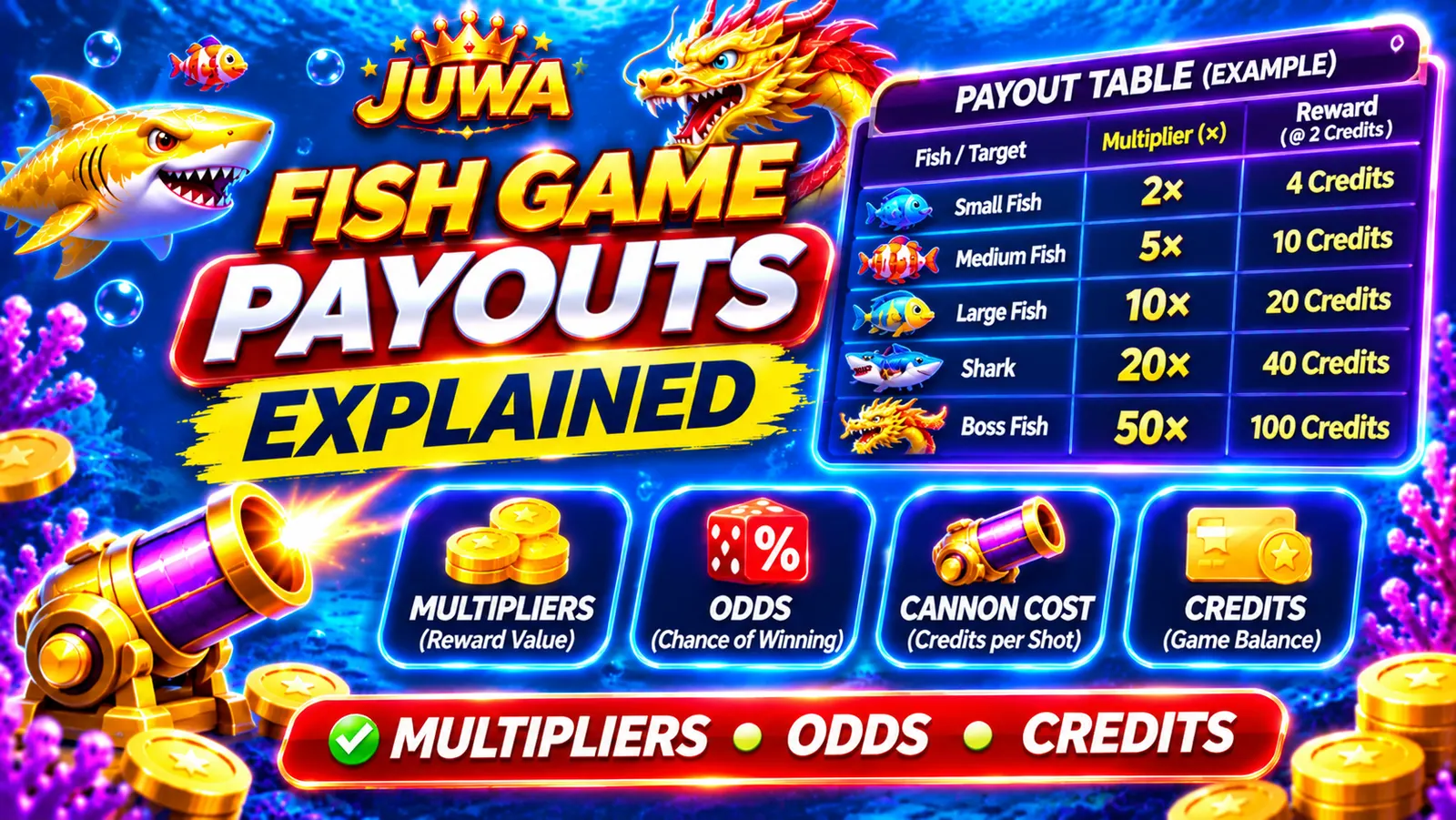
What does a fish game payout table actually mean? If you've played or explored fish shooting games on platforms such as Juwa, Fire Kirin, Orion Stars, or Ocean King, you may have noticed different target values, multipliers, cannon settings, and credit balances.
Understanding these numbers is important because a large multiplier does not necessarily mean a player has a higher chance of receiving a reward.
Fish arcade games combine moving underwater targets, shooting controls, and game-specific reward systems. However, different titles may calculate outcomes differently, and not every game publishes detailed information about its probabilities.
In this guide, you'll learn how to read fish game payout tables, understand multipliers, distinguish odds from rewards, and calculate credit costs using simple examples.
Quick Answer: What Is a Fish Game Payout Table?
A fish game payout table is a game information display that explains the rewards or values associated with different targets, events, or game features.
Depending on the title, a payout table may show:
Fish names or target categories
Reward values or multipliers
Special target information
Cannon or ammunition settings
Bonus features
Conditions for receiving a reward
Some games provide detailed information, while others offer only limited explanations.
Important: A payout multiplier tells you something about a possible reward. It does not, by itself, tell you the probability of receiving that reward.
1. How Do Fish Shooting Game Rewards Work?
Fish shooting games generally involve aiming a virtual cannon at moving underwater targets.
Each shot may consume a number of game credits according to the selected cannon setting.
When an eligible target is defeated, the game may award credits or points according to its rules.
However, the reward calculation depends on the individual game.
A Simple Example
Imagine a hypothetical fish game with the following settings:
Cannon cost: 2 credits per shot
Target multiplier: 10×
Successful reward: 20 credits
In this example, the reward calculation is:
2 credits × 10 = 20 credits
This is only an illustration of one possible multiplier system.
It does not establish how any specific Juwa, Fire Kirin, or Orion Stars title calculates rewards.
The player may have spent several shots before the target was defeated, so the total cost matters as well.
2. Understanding Fish Game Payout Multipliers
A multiplier is commonly written as a number followed by the multiplication symbol.
Examples include:
2×
5×
10×
20×
50×
A multiplier expresses a mathematical relationship between a base value and another amount.
In some games, the base value may be related to cannon cost, while other games may use fixed values or different formulas.
Example Multiplier Table
The following hypothetical table assumes each successful reward equals a multiplier times a base value of 2 credits.
MultiplierExample reward2×4 credits5×10 credits10×20 credits20×40 credits50×100 credits
These are illustrative calculations, not verified payout values for any particular game.
To understand the actual payout system, check the title's official rules.
3. Fish Game Odds vs Payouts: What's the Difference?
One of the most common misunderstandings about fish shooting games is confusing a reward multiplier with the probability of winning.
These concepts are different.
Payout
A payout describes the amount awarded when a qualifying outcome occurs.
Probability
Probability describes how likely an outcome is to occur.
Expected Value
Expected value combines the possible outcomes and their probabilities to describe an average result over repeated trials.
For example, a hypothetical game might award 20 credits for an outcome that has a 5% chance of occurring on one independent attempt.
The expected gross reward would be:
20 × 0.05 = 1 credit
If that attempt costs 2 credits, the expected net result would be:
1 − 2 = −1 credit
This example illustrates why a large advertised reward does not establish that a game is favorable to the player.
Actual fish game mechanics may be more complex, with dependent shots, target conditions, changing states, or undisclosed probabilities.
Unless reliable information is published, you cannot calculate the real expected return from a multiplier alone.
4. How Do Cannon Levels Affect Credit Costs?
Cannon levels may change the ammunition cost, firing behavior, or other mechanics.
For example, one hypothetical game might use:
Cannon settingCredits per shotCost of 10 shotsLevel 1110Level 2220Level 5550Level 1010100
The table demonstrates that higher per-shot costs can consume a balance more quickly.
It does not imply that every fish game uses these levels or that higher settings improve success probabilities.
How to Calculate Total Shooting Cost
Use this formula when the game deducts a fixed amount per shot:
Total shooting cost = Number of shots × Credits per shot
For example:
15 shots × 3 credits = 45 credits.
Understanding this calculation helps you track how quickly game credits are consumed.
5. What Is a Fish Game's Net Credit Change?
A reward displayed after defeating a fish is not necessarily the same as the player's net credit change.
To understand the net change in a simplified scenario, subtract the total credits spent from the total credits awarded.
Net credit change = Credits awarded − Credits spent
Example
Suppose a hypothetical session includes:
25 shots
2 credits spent per shot
40 credits awarded
Total credits spent:
25 × 2 = 50 credits.
Net credit change:
40 − 50 = −10 credits.
Even though the player received a 40-credit award, the overall credit balance decreased by 10 credits.
In a real game, additional mechanics or transactions may affect the balance.
6. Do Bigger Fish Always Have Higher Payouts?
Not necessarily.
Some games use visually larger fish or boss characters to represent special targets.
However, appearance alone does not establish the payout value, probability of success, or expected return.
Common Target Types
Fish arcade games may include:
Small fish
Medium fish
Large fish
Sharks
Sea dragons
Boss characters
Special golden targets
These are common visual categories rather than guaranteed reward classes.
The value and behavior of each target must be determined from the specific game's rules.
A visually impressive target should not be assumed to offer a better outcome.
7. What Are Boss Fish Payouts?
Boss fish are special or visually prominent targets in certain fish shooting games.
Some games connect these targets with distinctive reward systems, animations, or gameplay effects.
Depending on the title, a boss may have unique conditions for defeat or a different reward calculation.
Questions to Ask About Boss Fish
Before interpreting a boss target's displayed value, check:
Does the game explain the target's reward?
Is the amount fixed or multiplier-based?
Is the multiplier linked to cannon cost?
Are special conditions required?
Is the target's success probability disclosed?
Does the game explain any special feature or bonus?
Without this information, it is impossible to determine whether targeting a particular boss is financially advantageous.
8. How Does Auto Fire Affect Game Credits?
Auto fire is a feature available in some fish arcade titles.
It can allow a cannon to continue shooting without a separate manual input for every shot.
Although it may change how the player interacts with the game, auto fire does not inherently improve the mathematical return.
Example
Suppose automatic firing produces 20 shots at a cost of 3 credits each.
Total cost:
20 × 3 = 60 credits.
If the player does not monitor the credit balance, automatic firing may consume credits more quickly than expected.
The actual firing rate, stopping behavior, and credit rules depend on the specific game.
9. What Is Return to Player (RTP)?
Return to Player, commonly abbreviated RTP, is a theoretical measure used in some gambling games.
It represents the proportion of wagered value that a game is expected to return over a very large number of plays under specified conditions.
For example, a hypothetical game with a 95% theoretical RTP would return an average of 95 units for every 100 units wagered over a sufficiently large number of trials.
That does not mean an individual player will receive 95 units back during a short session.
Do Fish Games Publish RTP?
Not necessarily.
Some fish arcade titles do not provide enough publicly available information to verify their mathematical return.
Fish shooting mechanics can also be more complex than traditional slot games.
You should not assume any specific RTP for Juwa, Fire Kirin, Orion Stars, or another platform unless reliable documentation supports that exact figure.
10. Why Higher Multipliers Don't Guarantee Better Outcomes
A large multiplier can look attractive, especially when a game displays a target associated with a high reward value.
However, the potential reward is only one part of the calculation.
To evaluate the expected result, you would also need to understand the probability of receiving the award and any associated costs.
Hypothetical Comparison
FeatureTarget ATarget BPossible reward10 credits100 creditsExample probability20%1%Expected gross reward2 credits1 creditCost per attempt3 credits3 creditsExpected net result−1 credit−2 credits
This simplified example assumes independent attempts, fixed costs, and the stated hypothetical probabilities.
It demonstrates why a larger prize does not automatically mean a better expected outcome.
Actual fish games may not follow these assumptions.
11. Are Juwa, Fire Kirin, and Orion Stars Payout Tables the Same?
No universal payout table should be assumed across different platforms or games.
Juwa, Fire Kirin, and Orion Stars are listed as separate platforms on Juwadayvip.com.
The available fish games, reward information, controls, and credit systems may differ.
Juwa
Juwa is described as a platform combining fish tables and spinning slot-style games.
Individual fish titles may have their own rules and reward systems.
Fire Kirin
Fire Kirin is associated with arcade-style fish shooting games.
Specific target values and features should be checked within the relevant title.
Orion Stars
Orion Stars is another platform associated with fish arcade games and slots.
A reward factor from one title should not automatically be applied to another.
Quick Comparison
InformationJuwaFire KirinOrion StarsFish arcade gamesListedListedListedGame-specific rewardsVerify by titleVerify by titleVerify by titleCannon settingsGame-dependentGame-dependentGame-dependentMultiplier formulasNot universally establishedNot universally establishedNot universally establishedPublished RTPVerify availabilityVerify availabilityVerify availability
12. How to Find a Fish Game's Payout Information
If you want to understand how a particular title calculates rewards, begin with its official instructions.
Step-by-Step Checklist
Open the appropriate game.
Look for a help, information, or rules menu.
Check whether target reward values are listed.
Identify how cannon costs are calculated.
Read any multiplier explanations.
Review special-target conditions.
Check whether probability or RTP information is provided.
Confirm the meaning of the game's credit units.
Review any applicable promotional or redemption terms.
Contact official support if essential information is unclear.
Do not rely on an unverified third-party chart claiming guaranteed rewards or winning probabilities.
13. Common Fish Game Payout Misunderstandings
Myth 1: A 100× Fish Is Guaranteed to Pay More
A 100× multiplier may describe a potential award, but it does not establish how likely that award is to occur.
Myth 2: A Higher Cannon Level Always Improves Results
Higher settings can increase credit consumption. They do not automatically provide a better expected return.
Myth 3: Auto Fire Improves Winning Probability
Auto fire changes the input method, but its use does not inherently create a mathematical advantage.
Myth 4: Every Game Has the Same Reward Table
Different titles may use different reward calculations and game rules.
Myth 5: A Large Credit Award Means the Player Made a Profit
Total credits spent must also be considered, and virtual credits may not have cash value.
14. Frequently Asked Questions
What is a fish game payout table?
It is a display or explanation of the rewards, values, or multipliers associated with targets and special features in a fish shooting game.
What does 10× mean in a fish game?
It commonly represents a multiplier of ten times a base value. However, the actual base and reward conditions depend on the particular game.
Does a 100× fish have a higher winning chance?
Not necessarily. The multiplier and probability are different concepts.
What does a cannon level mean?
A cannon level may refer to ammunition cost, weapon behavior, or another adjustable game setting.
Are boss fish always worth more?
No. Their reward values and associated probabilities depend on the game rules.
Does auto fire increase payout rates?
There is no general basis for assuming that auto fire improves payout rates or expected returns.
Can you calculate fish game odds from the payout table?
Not always. A payout table may provide reward values without disclosing the probabilities needed to calculate expected returns.
What is RTP in fish shooting games?
RTP is a theoretical long-run return measure used in certain games. It should not be assumed to be available or comparable for every fish arcade title.
Do Juwa and Fire Kirin use the same payout multipliers?
Not necessarily. Individual games may have different rules and reward configurations.
Are fish game credits equivalent to real money?
Not automatically. Credit values, eligibility, and any redemption rights depend on the platform's actual terms.
Final Thoughts
Understanding fish game payout tables is about more than recognizing large multipliers.
Players should distinguish between possible rewards, probabilities, cannon costs, and the total credits consumed during gameplay.
A high multiplier does not guarantee success, and a visible credit award does not necessarily represent a positive net result.
Before participating in a fish shooting game, read the rules and understand how its credits and reward mechanics work.
To explore related topics, visit the Juwadayvip.com blog, or read about the fish and slot-style games available on the Juwa platform.
Responsible gaming reminder: Gambling-style games can involve financial losses. Follow applicable age and location restrictions, set spending limits, and never rely on gaming as a source of income.